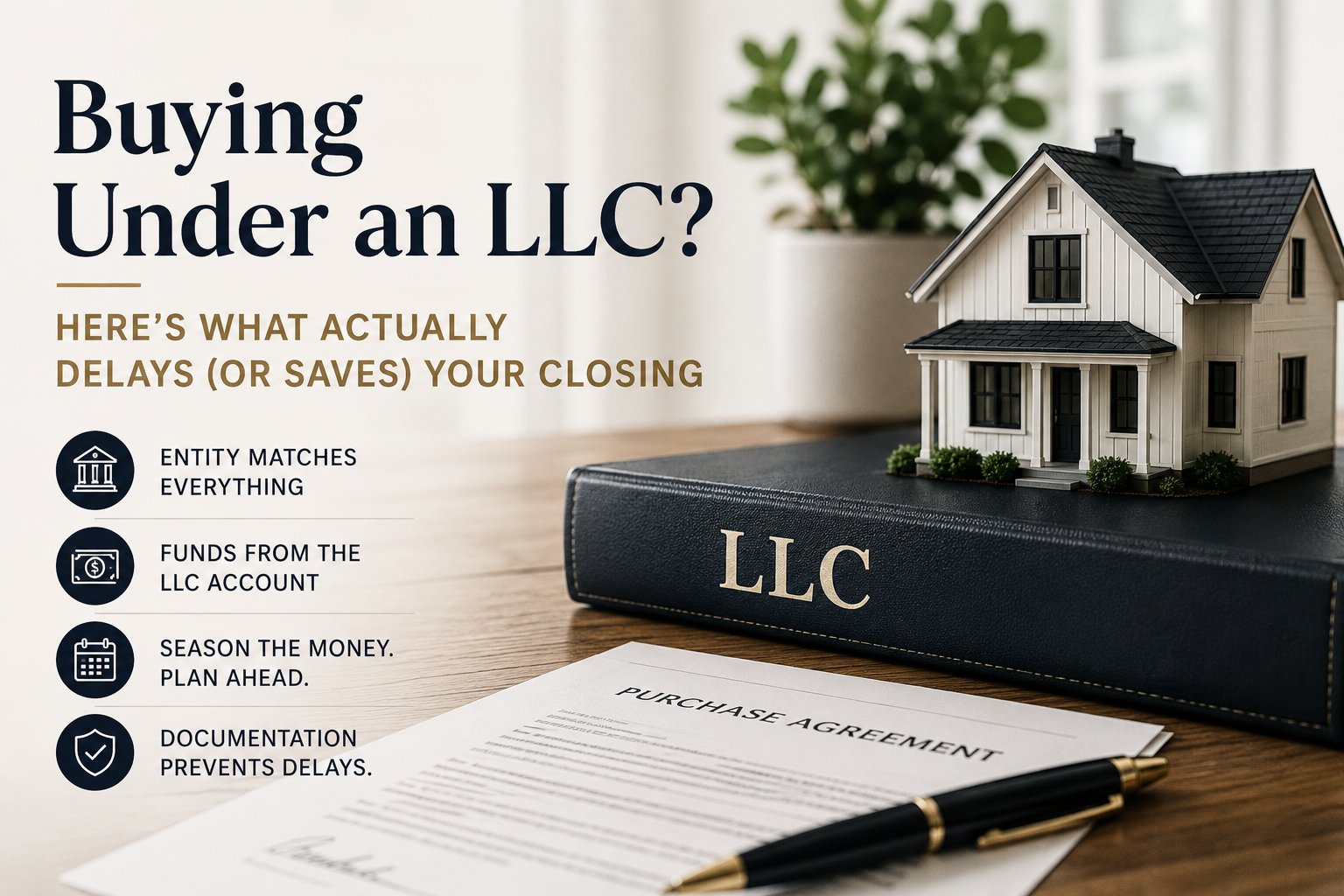
A couple from out of state found one of our new construction homes in Marvida through a video tour. Never set foot in Texas. Fell for the house, called their agent, and said: cash, closed in a week from contract execution.
Fast. Cash deals can move that fast — that’s kind of the whole point of cash. So our team scrambled, lined up everything on our end, and got the contract moving toward a one-week close.
Three days in, they called their agent with an update: they wanted to buy it under their LLC instead of their own names.
Fine. We can amend a contract for just about anything. Names, entities, closing dates — paperwork bends. But here’s the part that doesn’t bend: every fact of the sale has to line up with every other fact of the sale, or the deal stalls. And this one did.
Where It Went Sideways
The earnest money deposit had already gone out — from a bank account in both spouses’ personal names. Not the LLC’s account. Once they decided to close under the entity, that deposit source no longer matched the buyer on the contract.
Title companies aren’t being difficult when they flag this. They’re following anti-fraud rules that exist because wire fraud in real estate is a genuinely massive problem — the FBI’s Internet Crime Complaint Center tracked over $170 million in real estate fraud losses in a single recent year. So when the name on the contract and the name on the money don’t match, that’s not a technicality to a title company. That’s the exact pattern they’re trained to stop and question.
Then it got more complicated. Their proof of funds had originated from a cryptocurrency exchange. Crypto-to-cash isn’t inherently a problem, but it adds a documentation layer most buyers don’t expect: you need a clean paper trail showing the conversion, the receiving account, and enough time sitting in that account for underwriters — or in a cash deal, the title company’s compliance team — to consider it real.
Two structural issues, stacked on top of a one-week timeline. The math wasn’t going to work. Closing slipped ten days — not because anyone did anything wrong, but because nobody had planned the money trail to match the buyer they eventually decided to be.
The Rule Underneath All of This
If you’re buying real estate under an LLC — whether it’s a $600K new construction home in Cypress or a rental property three states over — the name that owns the money has to be the name on the contract, from the very first dollar.
That’s it. That’s the whole principle. Everything below is what happens when you break it, what it costs you, and how to not break it.
Decide on the Entity Before You Write the Offer
Not after. Not “we’ll figure it out.” Before.
If there’s any chance you might close under an LLC, form it — or at minimum, decide definitively — before your earnest money leaves an account. Retitling a contract mid-transaction is legally simple. Retroactively making your funds match an entity that didn’t exist when you sent the deposit is not simple. It’s the difference between a five-minute contract amendment and a ten-day documentation scramble.
Fund the Deal From the LLC’s Account, Every Single Time
Earnest money, option fee, cash to close, closing costs — all of it needs to originate from a bank account titled in the LLC’s name. Not a personal account “for now.” Not a joint account you’ll reimburse later. The LLC’s account.
Why title companies care this much: Texas has “good funds” requirements built into the Insurance and Property Codes specifically to keep unverifiable money out of escrow before it causes a problem. Wires over a certain threshold have to move through verified channels, and the source has to be traceable and legitimate. A mismatch between contract party and funding source is one of the first things that trips that wire.
Season the Money Before You Need It
“Seasoned” just means the funds have been sitting quietly in the account for a while — no mystery deposits showing up three days before closing. Lenders typically want to see 60 to 90 days of stability; on a cash deal, your title company will want something similar because they’re the ones vouching for the wire.
If you just formed the LLC and just funded its account, that money is, by definition, unseasoned. It might still close fine — but budget for extra questions and extra time, especially on a fast timeline. A one-week cash close and freshly seasoned funds don’t really coexist. Pick one to compromise on.
Cryptocurrency Proof of Funds Needs Its Own Runway
If your down payment or purchase funds are coming from a crypto sale, plan for it to take longer than a traditional wire, full stop. You’ll want documentation of the exchange transaction, the conversion to USD, and the receiving bank account — and ideally some time for that cash to sit before it needs to move again. Don’t assume your title company has seen this a hundred times and will wave it through. Some have, some haven’t, and either way they still have to document it.
The Federal Paperwork Almost Nobody’s Buyer’s Agent Has Mentioned Yet
Here’s the one that catches even experienced investors off guard right now, because it’s new. As of March 1, 2026, any non-financed residential purchase made by an LLC, corporation, or trust triggers a federal reporting requirement to FinCEN, the Treasury’s financial crimes unit. Your title or closing company — not you — has to file it, but you’re the one supplying the information: the real names, dates of birth, home addresses, and taxpayer ID numbers of anyone who owns more than 25% of the LLC or has substantial control over it.
It exists because all-cash entity purchases are the exact pattern regulators watch for money laundering. Your Marvida couple’s deal — out-of-state buyers, all cash, closing under an LLC — is textbook the kind of transaction this rule was written for. It doesn’t kill your deal or make you a suspect. It just means one more document request lands in your inbox mid-transaction, and if nobody warned you it was coming, it feels like a red flag instead of routine paperwork. Build the time for it into your timeline from day one.
If Your LLC Isn’t a Texas LLC
Plenty of buyers form their LLC in Delaware, Wyoming, or wherever their CPA set it up years ago — then try to use it to buy a house in Cypress. If that entity wasn’t formed in Texas, it may need to register as a “foreign LLC” with the Texas Secretary of State before it can legally transact business here. Whether a single real estate purchase technically triggers that requirement is genuinely a gray area, but title companies often want to see the registration — or a legal opinion that it isn’t required — before they’ll insure the transaction either way. That’s not something you find out at closing. It’s something to ask your attorney the week you decide to buy, not the week you’re supposed to close.
Prove You Can Actually Sign for the LLC
Being married and being co-owners of the LLC isn’t, by itself, enough for a title company. They’re going to want the Certificate of Formation, the EIN, and usually the operating agreement or a signed resolution showing exactly who has authority to bind the entity and sign closing documents. For a two-member LLC where both spouses are owners, that often means both of you need to be documented as authorized signers in the entity’s own paperwork — not just assumed to have authority because you’re married and it’s “our LLC.” Get this document in hand before you’re at the closing table, not while you’re sitting at it.
Your Insurance Policy Changes — and So Does the Bill
This is one people genuinely don’t see coming. A standard homeowner’s policy (an HO-3, the kind most Texans carry) is underwritten for an individual occupying their own home. Once an LLC holds title, plenty of carriers won’t write that same policy — even if the couple plans to live there themselves. Instead you’re often pushed into a landlord or dwelling-fire policy (a DP-3), which is priced and structured for a non-owner-occupied property.
The practical difference: DP-3 policies typically carry different — often higher — premiums than an equivalent HO-3, and some personal-liability and personal-property protections that come standard on a homeowner’s policy aren’t automatically included and have to be added back as endorsements. So the couple isn’t just filling out different insurance paperwork. They may be paying a different price for a differently shaped policy, on the same house, for the same coverage they assumed they’d have.
What Losing Homestead Status Actually Costs, in Dollars
“You lose your homestead exemption” undersells what’s actually happening. Losing homestead status costs money two separate ways, not one.
The exemption itself. Texas’ standard school-district homestead exemption knocks $100,000 off the taxable value of an owner-occupied home. An LLC-owned property gets none of that. On a $500,000 home, that’s the difference between paying school taxes on $500,000 versus $400,000 — every single year, for as long as the entity owns it.
The appraisal cap — the bigger long-term risk. This is the part that surprises people. A homesteaded property in Texas has its taxable appraised value capped at a 10% increase per year, no matter how hot the market gets. Non-homestead property — including anything owned by an LLC — currently gets a temporary 20% cap through the 2026 tax year, and after that, nothing caps it at all unless the legislature renews it. In a fast-appreciating area like Marvida, that’s real exposure: a home that jumps 25–30% in market value in a strong year could see its full assessed value taxed accordingly, with no 10% ceiling protecting the entity from that spike the way it would protect an individual owner.
Stack those together and an LLC-owned home isn’t just paying somewhat more in property taxes. It’s carrying meaningfully more long-term exposure to tax bills that can move fast in a market that’s still growing.
Selling Later Costs More, Too
If this becomes a primary residence and they ever sell, IRS Section 121 lets an individual homeowner exclude up to $250,000 of capital gain from the sale ($500,000 for a married couple filing jointly) — but only if the home is titled to individuals, not an entity. An LLC-owned home doesn’t get that exclusion. On real appreciation in a growing Houston submarket, that’s not a rounding error; that’s potentially tens of thousands of dollars in capital gains tax an individual owner simply wouldn’t have owed.
Financing Gets Pricier If They Ever Need It Later
They closed in cash this time, so it’s not an issue today — but it’s worth knowing before it becomes one. Conventional, FHA, and VA loans are underwritten for individual borrowers, not entities. If this couple ever wants to refinance or pull equity out of an LLC-owned property, they’re generally routed into commercial or DSCR (debt-service coverage ratio) lending — which typically carries higher rates and different underwriting than a standard residential loan, and sometimes still requires a personal guaranty anyway, which quietly undercuts part of the liability protection they bought the LLC for in the first place.
The Quick Version
Do:
- Decide on your buying entity before contract execution, not mid-transaction
- Fund every deposit and closing cost from the LLC’s own account
- Give your money time to season — plan for weeks, not days, if the account is new
- Document crypto-to-cash conversions thoroughly and early
- Ask your closing team about FinCEN reporting requirements up front, and have beneficial owner information ready
- Confirm whether your LLC needs to register as a foreign entity in Texas before you’re mid-contract
- Get your Certificate of Formation, EIN, and signing authority documentation together before closing week
- Call your insurance agent early and ask specifically how entity ownership changes your policy type and premium
- Talk to a CPA or attorney about the homestead, appraisal cap, and capital gains trade-offs before you decide entity vs. personal name, especially for a primary residence
- Tell your agent and title company the entity plan on day one, not day three
Don’t:
- Send earnest money from a personal account if you plan to close under an LLC
- Assume a fast cash close and fresh entity funds can coexist
- Underestimate how long crypto-sourced funds take to clear compliance review
- Assume your homeowner’s policy carries over unchanged once an entity holds title
- Put your primary residence in an LLC without understanding what you’re giving up on property tax exposure and capital gains treatment
- Change entities mid-contract and expect the timeline to hold
Structuring isn’t paperwork you handle after you fall in love with a house. It’s a decision that belongs at the very start — right alongside price and closing date — because the money, the entity, and every document behind it all have to tell the same story from the first dollar to the closing table.
Talk to Fay
Thinking about buying — or already under contract — as an LLC? Let’s get your entity, funding, and documentation lined up before it costs you days at closing.
Book a Free Consultation →