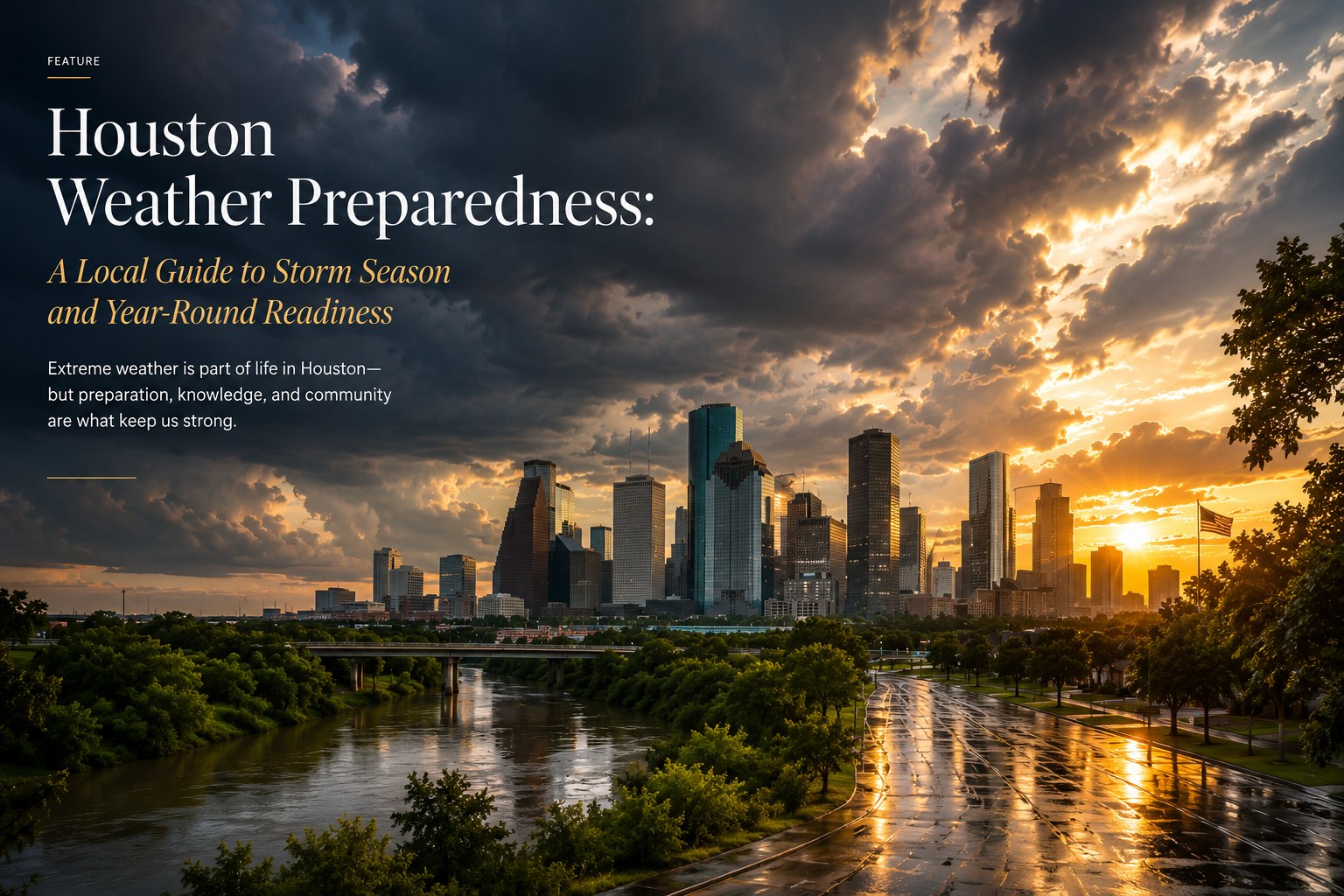
As we sit in the middle of another active stretch of the 2026 hurricane season — Tropical Storm Bertha among the systems that have already moved through, with forecasters watching a strong El Niño reshape the whole pattern this year — the thunder rolling through right now is loud enough to rattle the windows and shake the house like a small earthquake. It's a sound that puts things in perspective fast. It reminds me how small and vulnerable we really are against something this size. It also reminds me how fortunate and grateful I am to live in a city full of people with hearts as big as the storms we deal with.
There's a saying around here that Houston only has two seasons: hot, and hot with a threat level attached. Summers are a special kind of muggy that makes you understand why every porch has a ceiling fan running year-round. Every few winters, an arctic front slides down and reminds us that our grid wasn't exactly built with Texas in mind. And then there's the big one — hurricane season, tornado warnings that pop up out of nowhere on a Tuesday afternoon, and the kind of rain that turns a street into a river in under an hour.
None of this happens constantly. Most years, you get through it with nothing worse than a lost afternoon of power and a soggy yard. But when it does happen — and eventually, it will — it takes a real toll on this city. The flip side, the part that keeps people here instead of running for higher, drier ground, is what happens next. Houston shows up for itself in a way I haven't seen anywhere else.
I'm not writing any of this from the sidelines. I was a student at LSU in Baton Rouge in 2005 when Hurricane Katrina hit, close enough to New Orleans to feel the full weight of it. And I was living in Westbury in 2017 when Harvey parked itself over Houston for the better part of a week. I've seen this kind of storm from both sides of the Louisiana-Texas line, twelve years apart, and one thing hasn't changed: the way a community pulls together when the water starts rising is every bit as real as the danger itself.
The City That Shows Up
During Hurricane Harvey, while the news was still showing water rising in real time, regular people were already out in bass boats and jon boats pulling neighbors off rooftops and out of flooded subdivisions — organized on the fly through Facebook groups and walkie-talkie apps, no official chain of command required. People now call it the "Cajun Navy," but plenty of the boats out there that week never had a fancy name. They just had gas in the tank and a Houstonian behind the wheel who figured somebody needed to go.
Jim McIngvale — Mattress Mack, to basically everyone in this city — threw open Gallery Furniture's doors and turned showroom floors into a shelter, beds and all. HEB parking lots and church fellowship halls became supply depots overnight. During the 2021 freeze, when half the city lost power at once, it was neighbors running extension cords across fences to keep an elderly couple's heat lamp going, or checking in block by block on Nextdoor to find out who still had water pressure and who didn't.
I saw a version of that same instinct play out in Baton Rouge during Katrina, and I wasn't just watching it happen. LSU's campus basically became a city within a city — the Pete Maravich Assembly Center, normally a basketball arena, turned into what ended up being the largest acute care field hospital in U.S. history, treating and triaging tens of thousands of evacuees in a matter of weeks. Baton Rouge's population nearly doubled overnight as people arrived with nothing, and LSU students showed up around the clock, at two in the afternoon and two in the morning, to do whatever needed doing — pushing wheelchairs, entertaining kids, running supplies. My friends and I were among the students who didn't evacuate and stepped up to volunteer inside that field hospital, helping care for people who'd come out of New Orleans with next to nothing. Nobody assigned most of those shifts. People just came. In the weeks after the storm, I was also part of an effort through the LSU School of Art to get displaced kids something to help them process what they'd just been through — restocking them with art supplies for trauma recovery and a return to something like normal, using donations that poured in from all over the world.
That's the part of this story I want people to hold onto before we get into the sobering stuff. Because the preparation matters, but so does knowing what kind of place has your back when the preparation isn't enough.
Where This City Actually Floods
Houston is nicknamed the Bayou City for a reason — twenty-two interconnected bayous run through it, and the whole city was essentially engineered around them. During normal rain events, that system works. Streets are graded to fill first and drain slower than yards on purpose, so water goes into the road before it goes into your living room. It's not a flaw. It's the plan.
The plan has limits, though, and Houston has hit them more than once in the last decade. In April 2016, the Tax Day flood dumped close to two feet of rain in some spots in a single day, damaged more than ten thousand homes, and pushed the Addicks and Barker reservoirs to record levels — a record that would only stand for sixteen months. Cypress Creek, Langham Creek, and the area around Katy took some of the hardest hits, which means this wasn't some far-off downtown problem. It happened close to home for a lot of the families I work with now.
Then came Harvey in 2017, which made Tax Day look like a warm-up. More than fifty inches of rain fell over several days. Streets that had never flooded before went under. And this is the part that doesn't get talked about enough: some of the worst flooding didn't come from a bayou overflowing its banks at all. It came from a reservoir.
The Addicks and Barker reservoirs sit mostly dry, year-round — they're the kind of place with soccer fields and walking trails when it's not storming. But they exist for one purpose: to hold floodwater back from downtown Houston during a major event. During Harvey, they filled to levels no one had planned for, and thousands of homes built inside that reservoir footprint — many owners never realizing they were inside a flood control structure at all — went underwater. Then, to keep the dams themselves from failing catastrophically, the Army Corps of Engineers opened the gates and released water downstream into Buffalo Bayou, which flooded thousands of additional homes that hadn't taken on a drop of storm water until that release happened.
That decision has been in court for years. A federal judge ruled the flooding amounted to a legal "taking" of private property, and homeowners — both upstream and downstream — have been awarded compensation in phases ever since, with rulings still coming down as recently as this year. One detail worth knowing if you're house hunting anywhere near the Katy Prairie: buyers who purchased property after August 30, 2017, generally can't rely on that same legal protection, since the risk had already become public knowledge by then. If you're looking at homes in Cinco Ranch, Kelliwood, Grand Lakes, or anywhere near that reservoir system, this isn't ancient history — it's a live consideration.
FEMA flood maps are a useful starting point, but they're not the whole picture. A Harris County analysis after Harvey found that three out of every four homes that flooded were actually outside the mapped 100-year floodplain. Rice University's interactive Tax Day flood simulation map lets you explore what a Tax Day–scale event would look like across specific Houston-area watersheds today, and their early findings suggest the danger zone is bigger than most people assume, stretching into neighborhoods that have never flooded before. One researcher put it plainly: in Houston, "not in a flood zone" is a dangerous misnomer, since FEMA's lines are actuarial, not physical — being outside them doesn't mean being safe. If you're buying anywhere in Greater Houston, that tool is worth five minutes before you fall in love with a house.
Check Your Own Address
A static flood map only tells you so much. The Harris County Flood Education Mapping Tool lets you type in any address and see exactly which floodplains — 100-year, 500-year, or coastal — touch that specific property, plus the watershed it sits in. It's free, built by Harris County Flood Control District, and worth five minutes before you fall in love with a house.
Open the Interactive Map →Getting Ready Before the Sky Turns Green
Know your zone, even if you think you don't need to. Harris County breaks hurricane risk into "zip zones" — Coastal, A, B, and C — based on storm surge threat, and evacuations are staggered by zone to keep the highways from locking up completely. Most of my Cypress, Bridgeland, and Cross Creek Ranch clients live well outside a mandatory surge evacuation zone. Your real risk out here is rainfall flooding and wind, not storm surge — but check ReadyHarris.org for your specific zip code instead of assuming. It takes two minutes and it's worth knowing before a storm's already in the Gulf.
Learn your route before you need it. I-10, I-45, US-290, and I-69 are the primary evacuation corridors, and TxDOT can flip inbound lanes to outbound — contraflow — when volume demands it. You don't need to memorize a map. You just need to know which highway you'd take and have a tank of gas that doesn't wait until the storm is already named.
Insurance is a "before" problem, not a "during" one. Here's something a lot of buyers don't find out until it's too late: once a named storm enters the Gulf, insurance carriers across Texas stop writing new policies and stop increasing coverage on existing ones. It's called a binding moratorium, and during peak season — August through October — it can last a week or two instead of a day or two. If you're closing on a house during hurricane season and haven't bound your coverage yet, a storm entering the Gulf can leave you stuck, unable to close, watching your rate lock tick toward expiration. This is exactly why a good agent gets ahead of it.
And it's not just about timing — it's about knowing the real number before you commit. A house's insurance cost isn't one line item; it's homeowners coverage, windstorm coverage where required, and flood insurance as a separate policy entirely, and all three can vary a lot from one address to the next depending on elevation, roof age, and proximity to a flood pool. Before you write an offer on a home you love, get an actual quote on that specific address. I've had clients fall for a house only to find out the true carrying cost — insurance included — didn't fit their budget the way the mortgage payment alone suggested it would. Better to know at the offer stage than at the closing table. This is where my prior licensing as an insurance claims adjuster comes in clutch — it's knowledge and experience that's easy to overlook in all the excitement of finally getting to make a big move, but it's exactly the kind of detail that can make or break whether a house actually fits your budget once every real cost is on the table.
A note on coverage: flood insurance is not part of a standard homeowners policy — it's a separate policy entirely, typically through the National Flood Insurance Program or a private flood carrier. A standard homeowners policy covers things like fire, theft, and most wind damage, but windstorm coverage may require its own separate policy or rider depending on where you live, and it excludes flooding caused by rising water regardless. Three different perils, three potentially different policies. Don't assume one covers what the others don't.
Build the kit before you need it, not during the countdown. Sandbags, a couple of flat shovels, plastic sheeting, and a wet-vac live in my garage year-round, not just during hurricane season. Beyond that, every household needs emergency food and water that doesn't need power to prepare, plus fuel for the car and any generator, and blankets in case heat or AC goes out for days instead of hours. And pack a go-bag before you ever need one: a set of clothes sealed in airtight plastic bags, kept in a duffle you can grab in thirty seconds, whether you're staying put or heading out the door.
A word on how you store all of that: no container is heat-proof, so where you keep it matters as much as what's in it. Bottled water and canned or jarred goods left in a hot garage or car for long stretches will degrade faster and can become a real food-safety risk above 100 degrees — that's true whether it's in plastic, metal, or glass. Glass avoids chemical leaching, but it isn't a shortcut around heat, and it brings its own risk in a freeze: a sealed glass jar that freezes can crack or lose its seal entirely. MREs and powdered or freeze-dried meals tend to hold up best across temperature swings — roughly three years of shelf life at 80 degrees, dropping closer to six months if they're baking at 100 — but even those do best in an interior closet, not the garage. Costco, Amazon, and similar warehouse retailers now sell freeze-dried emergency food buckets built for exactly this — enough entrees for a family of four to eat two meals a day for around two weeks, rated for a 25-year shelf life — which makes a solid base for a kit as long as you've also got the water on hand to rehydrate it. Whatever you choose, keep it somewhere temperature-stable, and rotate it — check it every few months, not just when a storm's already in the Gulf. For winter, it's pipe insulation, dripping faucets during a hard freeze, and knowing exactly where your shutoff valve is before you're standing in the dark trying to find it.
When It's Actually Happening
Not every storm means evacuate. That's not me second-guessing anyone who does — evacuating is often the smartest, safest call, and I'd never tell someone not to make it. But I can tell you what staying looked like for my family during Harvey, because I lived it firsthand.
I was living in Westbury when Harvey hit — a neighborhood that, like a lot of southwest Houston, sits close enough to Brays Bayou to know exactly what "close" means during a week of nonstop rain. I stayed because I didn't have a choice, honestly. I was a nurse at the time, on call right up until landfall, and I needed to be there to relieve the shift that got forced to stay at the hospital for the duration of the storm. It really was a coin flip — I could just as easily have been on the other side of that, one of the staff stuck at the hospital, cut off from family and friends for days once the phone lines and cell towers went down. I don't envy the ones who drew that assignment. I was lucky. I at least had my husband and my brother with me.
Days of deluge had water pooling and rising steadily in the backyard, and it was clear that if it kept climbing, it was going to reach the house. My brother and my husband made a call: instead of waiting it out and hoping, they went outside in the middle of it and dug a trench — around the back of the house, along the sides, out to the front — giving the rising water a path to the lower ground at the street instead of a path into our walls.
We still ended up with a couple of inches of water in the garage. But we'd stocked up on sandbags ahead of time, and between those and a couple of push brooms working nonstop to sweep water back out from under the door, we kept most of it out. It helped that the garage was concrete, floor and walls, and sat lower than the rest of the house — so even with those couple of inches, nothing made it past the garage and into the living space.
What we did get was a tree limb through the roof, and water that worked its way down into the bathroom walls and ceiling underneath it — which, a few days later, meant mold, torn-out drywall, and a full rebuild of that section of the house. Minor, in the scale of what a lot of our neighbors went through. But it's a real reminder that even a "we made it" story usually still comes with a punch list.
I'm not telling that story as a how-to. Digging a trench isn't a universal fix — it depends entirely on your yard's slope, your soil, and where the water actually wants to go, and doing it wrong can just as easily send water toward a house instead of away from it. I'm telling it because it's true, because it's exactly the kind of decision people in this city make in real time, and because it's a good example of why knowing your own property — its drainage, its low points, its escape routes for water — matters just as much as knowing the interstate out of town.
The 2021 freeze called for a completely different decision. My daughter was just 22 months old, and when the power grid started failing across the city, my husband and I packed her up and braved the icy roads to get to my mother-in-law's house, because she had a gas fireplace and a gas stove that were still working. That heat and that stovetop got us through the next several days. At the time, we were living in a rental, and a generator simply wasn't something we could justify buying for a property that wasn't ours — so leaving for somewhere with a reliable heat source wasn't a backup plan, it was the plan.
I tell both of these stories — the trench during Harvey and the drive to my mother-in-law's during the freeze — not to scare anyone away from this city, but to show exactly how much being prepared actually matters, and how differently "prepared" can look depending on your situation. If I'd owned a generator back then, that freeze might have looked completely different. But I didn't, because renting didn't make that investment make sense yet. It's one more reason homeownership isn't just about equity — it's about having the ability to make the improvements and investments that actually protect your family when the weather turns.
Whatever you decide, monitor actively. The National Weather Service, the Harris County Flood Warning System's stream gauges, and Houston TranStar's live traffic cameras are all better tools than just watching the news scroll by. And if water starts moving across a road, turn around. It doesn't matter how well you know that street.
After the Water Goes Down
Mold doesn't wait politely. In our case, it was just a few days between the leak and the point where the drywall under that roof damage was beyond saving — and that's typical, not extreme. If your home takes on water or a leak from wind damage, dry it out or get it torn out fast, because the clock is shorter than people expect.
Photograph everything before you touch anything, then call your carrier. If you're dealing with both wind and flood damage from the same event, remember those are usually two separate policies with two separate claims processes — don't assume one covers the other.
Real Estate Assistance for Storm-Affected Buyers
If Harvey affected you specifically and you're a first-time homebuyer today, it's worth knowing the City of Houston runs the Harvey Homebuyer Assistance Program 2.0 (HbAP 2.0), offering up to $125,000 in down payment assistance, closing cost help, and principal reduction for eligible buyers who lived within Houston's city limits on August 25, 2017. One catch worth knowing up front: it's a city program, not a county one, so if you were in unincorporated Harris County — Cypress, Bridgeland, and a lot of this corridor included — it may not apply to you directly, though it's worth checking your specific address against the eligibility map before ruling it out. There's a separate program for the 2021 freeze, too — the Winter Storm Home Repair Program, offering reimbursement up to $10,000 for repairs already made, or up to $300,000 for more substantial work for homeowners who couldn't afford repairs at the time.
Why We Stay
None of this is meant to scare anyone off. If anything, it's the opposite.
Because here's what people who've never lived here don't understand: Houston isn't just a place you tolerate between storms. It's the most diverse city in the country, and you can taste that on every block — Vietnamese-Cajun crawfish boils, Tex-Mex that doesn't apologize for itself, taco trucks parked outside dive bars, dim sum in Chinatown, and a barbecue scene that argues with itself daily about whose brisket is better. You could eat somewhere different every night for a year and still not run out of neighborhoods to try.
It's a genuine arts and culture town, not a pretend one — the Museum District alone holds nineteen museums within walking distance of each other, the Theater District is the largest concentration of performing arts venues outside New York, and the Houston Symphony, Grand Opera, and Ballet all call this city home. Add in the Astros, the Texans, the Rockets, and three weeks every spring where the entire city smells like fried food and cattle at the Rodeo, and there's genuinely something happening here every single week of the year.
It's also a city that will actually build a career under you. The Texas Medical Center is the largest medical complex on Earth, not just in Texas — which is exactly why so much of my business is helping medical professionals relocate here in the first place. The energy sector still anchors a huge share of the economy, NASA's Johnson Space Center is a twenty-minute drive from downtown, and the port is one of the busiest in the country. Whatever field you're in, there's a real chance Houston has a place for it.
And underneath all of that is something harder to put a price on: community. Churches and synagogues and mosques and temples that actually function as extended family, not just Sunday obligations. Running clubs, car clubs, book clubs, rec leagues, volunteer groups — whatever your thing is, there's a group of Houstonians already doing it together, and they'll welcome you in without much of a wait.
That's the part that's hardest to explain to someone who hasn't lived in the South. Down here, your friends become your family, not just a substitute for the one you left behind. People show up at your door with a casserole because they heard you had a rough week, not because they were asked to. Guests get treated like they've been coming around for years, even on their first visit. We are generous and hospitable almost to a fault — and that same instinct is exactly what turns a furniture store into a shelter and a stranger with a boat into a rescue worker the moment things go sideways. It's not a different personality that shows up during a storm. It's the same one that shows up every single day, just turned up louder when it's needed most.
I've lived through the mold, the roof, the trench in the backyard at two in the morning, the drive through icy roads with a toddler in the backseat — and I still choose this city, on purpose, every year hurricane season rolls back around. Houston floods sometimes. Houston freezes sometimes. And every single time, it also proves all over again why so many of us never seriously consider leaving.
That's worth preparing for. It's also worth staying for.
This article is for general informational purposes and reflects publicly available programs, legal rulings, and personal experience as of publication. Insurance availability, flood risk, and assistance program eligibility can change and should be confirmed directly with your insurance carrier, the relevant city or county agency, and a licensed real estate professional before making decisions based on this information.
Talk to Fay
Getting ready to buy in Greater Houston and want to know the real flood and insurance picture for a specific address before you write an offer? Let's talk it through.
Book a Free Consultation →