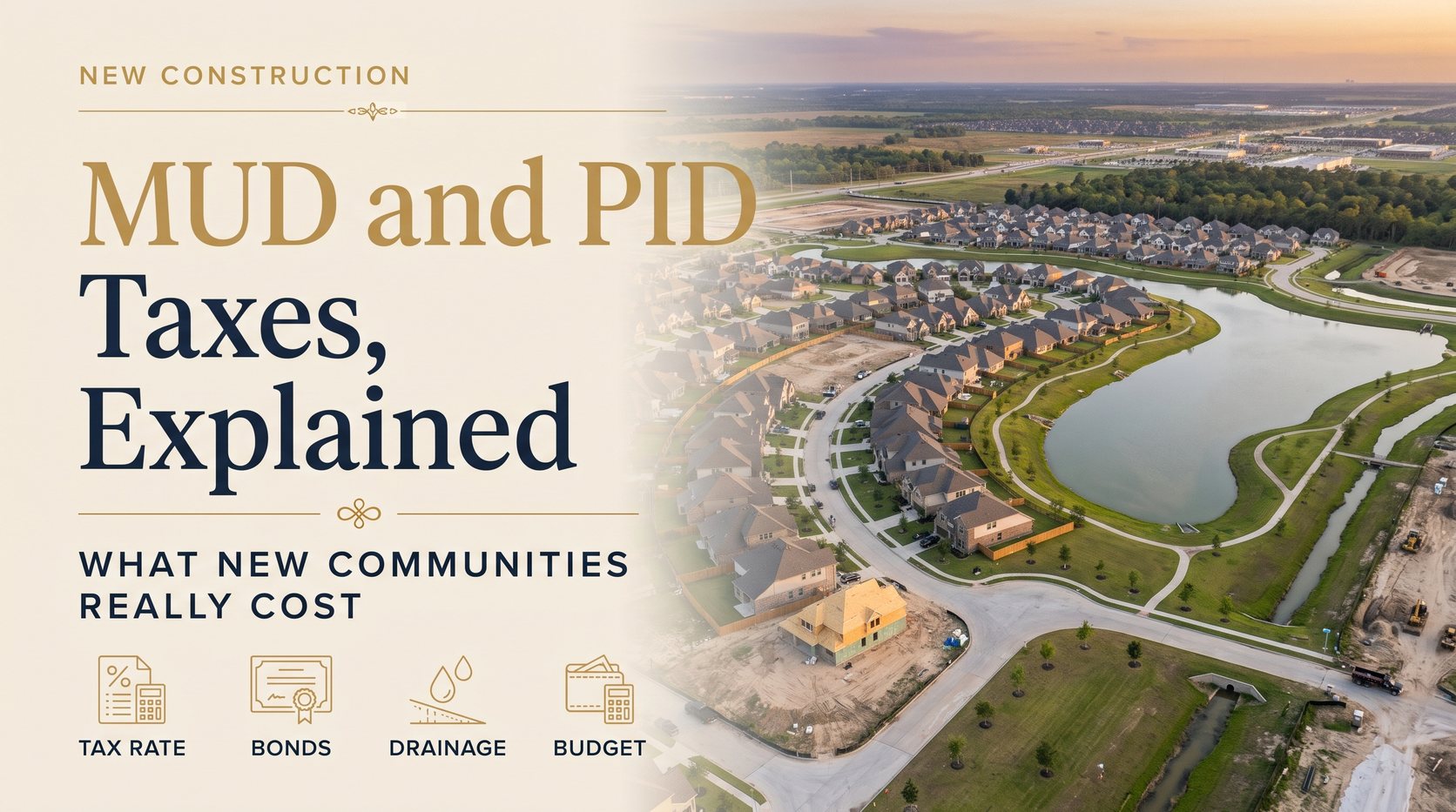
What are MUD and PID taxes? They're charges on top of your regular property taxes that pay for the roads, water lines, drainage and amenities in many new Houston-area communities. A MUD, or municipal utility district, levies a tax rate that can change every year. A PID, or public improvement district, charges a fixed assessment for a set number of years.
Both are normal in master-planned communities around Cypress, Katy and the Grand Parkway, and neither is a reason to skip a neighborhood. They are a reason to compare total monthly cost, not just price, before you pick a house.
How does a MUD tax work?
Developers use MUDs to finance water, sewer and drainage infrastructure with bonds, and homeowners in the district repay those bonds through a tax rate, set each year per $100 of value, on top of the school, county and other rates. The Texas Real Estate Research Center notes that MUDs can keep issuing bonds as the district builds out, so there's no set end date. Rates often come down as more homes are built and the tax base grows, but that isn't guaranteed.
An illustration: on a $400,000 home, a MUD rate of 80 cents per $100 would add about $3,200 a year, or roughly $267 a month, to your escrow payment. Your actual rate depends on the district.
Ask for the number early. Every builder's sales office has it.
How is a PID different?
A PID assessment is a fixed amount that pays off bonds for specific improvements over a set term. You can usually pay it off early to save interest, and Texas requires the seller to give you a PID notice before you sign a binding contract. That rule has applied since September 2021, and if the notice doesn't come before the contract, the buyer generally has the right to terminate before closing and get the earnest money back. The notice itself doesn't have to list the dollar amount, so ask the seller or builder for the current installment, the remaining term and the payoff figure in writing.
| MUD | PID | |
|---|---|---|
| What it pays for | Water, sewer, drainage, sometimes parks and roads | Specific improvements like roads, landscaping or amenities |
| How it's charged | Tax rate per $100 of value, set yearly | Fixed annual installment |
| How long | No set end date | Set term, with early payoff allowed |
| Notice before contract | Required under the Texas Water Code | Required under Property Code §5.014 |
What to check before you buy in a new community
- Every taxing unit on the property, including MUD, PID and any defined-area tax. Ask the builder's sales office, then confirm with the county appraisal district and tax office.
- The MUD's current rate and recent history. Most districts post them on their websites.
- For a PID, the annual installment, the years left and the payoff amount.
- Whether your lender has included both in the payment estimate. They should be in escrow.
Why does the first tax bill on a new home look so low?
Because the appraisal district values property as of January 1. If your home was a slab or a framed shell on that date, your first bill may be based mostly on the lot. The next year it's appraised as a finished house, and the escrow account can come up short, which can raise your payment. Budget for the full tax from day one and file your homestead exemption as soon as you qualify.
For the full picture of Houston taxes, see my Houston property tax guide. If you're buying to rent, this breakdown of MUD and HOA costs for rentals runs the numbers. And my new construction page explains how I help buyers compare communities.
Frequently asked questions
What is a MUD tax in Houston? A municipal utility district tax pays off bonds for water, sewer and drainage infrastructure in a community. It's a rate per $100 of value, set each year and added to your other property taxes.
What is a PID assessment in Texas? A public improvement district assessment is a fixed annual installment that pays for specific improvements over a set term. It can usually be paid off early.
Do MUD taxes ever go away? There's no set end date, since a MUD can issue bonds as the district builds out. Rates often decline as more homes are built and the tax base grows, but that isn't guaranteed.
Does the seller have to tell me about a MUD or PID? Yes. Texas requires a MUD notice under the Water Code and a PID notice under Property Code section 5.014, both before you sign a binding contract.
Why did my property taxes go up after my first year in a new home? Homes are appraised as of January 1. If your home wasn't finished then, the first bill may reflect mostly the lot, and the next year's bill reflects the finished house.
This article is general information, not tax or legal advice. Tax rates and assessments vary by district and change each year. Confirm the figures for any property with the appraisal district and tax office.
Last updated November 2026