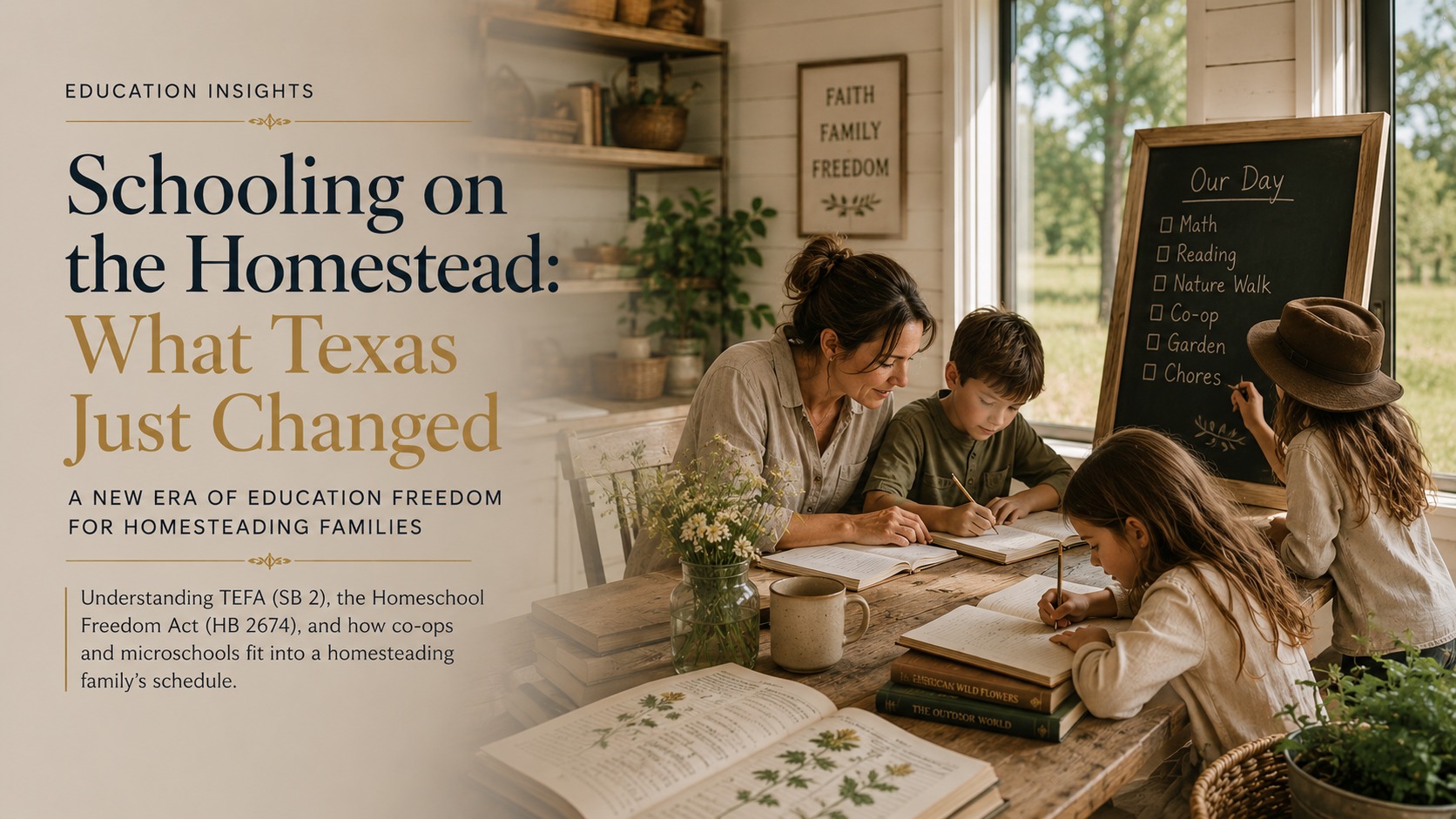
Every homesteading family I talk to eventually asks some version of the same question, usually a little sheepishly, like they expect me to have an opinion about it: what do we do about school? It makes sense. If you're picturing five acres, a garden, and a couple of goats, the image of two kids climbing onto a bus at 7 a.m. doesn't really fit the life you're building. And it turns out Texas just made that tension a lot easier to resolve than it was even a year ago.
The law that changed things: SB 2, the Texas Education Freedom Account program. Passed in the 2025 legislative session, this is a genuine education savings account program — real state money, not just a tax break, that families can put toward alternatives to their assigned public school. Homeschool families qualify for up to $2,000 per student per year. Families choosing private school options can receive roughly $10,300 to $10,474 per year, with significantly more available for students with disabilities — up to $30,000 in some cases. Applications opened in February 2026 for the 2026–27 school year, so if you're planning a homestead move with school-age kids, this is very much live and worth factoring into your budget right now, not a someday-maybe program.
The companion law: HB 2674, the Homeschool Freedom Act. This one matters just as much in a quieter way. It locks in that the state can't pile new regulations onto homeschooling families going forward. If part of your hesitation about homeschooling has been "what if the rules get more complicated later," this law is specifically designed to answer that worry with a legal guardrail, not just a promise.
Here's what this actually means for a homesteading family's day-to-day math. Running a homestead is genuinely demanding — animals don't take snow days, gardens don't pause for a field trip. A lot of families I talk to assume homeschooling means one parent effectively becomes a full-time, unpaid teacher on top of everything else the property demands, and that math doesn't work for a lot of households. TEFA doesn't erase that demand, but it changes what's actually affordable. That $2,000 per homeschool student can go toward curriculum, tutoring for subjects you don't feel confident teaching yourself, or a co-op membership — which brings me to the piece most people don't picture when they think about homeschooling.
Co-ops and microschools are the realistic answer for most homesteading families, not solo kitchen-table homeschooling. The image people default to — one parent, one kitchen table, teaching every subject alone — is genuinely rare among the homesteading families I work with. What's far more common is a hybrid: kids enrolled in a homeschool co-op that meets a few days a week for group instruction, sports, and the subjects parents don't want to teach themselves, with the rest of the week structured around the property. Microschools — small, often multi-age classrooms run out of a home or a small dedicated space, sometimes by a single qualified teacher serving a handful of families — have grown specifically to serve this gap between full-time traditional school and fully independent homeschooling. Houston's homesteading and rural communities have a real, if not always well-advertised, network of both.
A practical note if you're actually planning this move: TEFA applications, co-op enrollment, and microschool waitlists all tend to run on their own calendars, separate from your home closing timeline. If schooling is part of your homestead plan, it's worth starting that research well before your move date, not after — the same way you'd start researching ag exemptions or well permitting early. Rollout details on TEFA were still being finalized as this program launched, so I'd recommend checking texaseducationfreedom.gov or your local co-op network directly for the most current application windows before you build your family's calendar around it.
The bigger picture here: Texas didn't just make homesteading more financially reachable this year through land grants and ag exemptions. It made the whole lifestyle more reachable by taking one of the biggest practical worries — what happens to school — and giving families real financial help and legal stability around it. That's not a small thing, and it's exactly the kind of shift that's quietly driving more families to consider this move than would have seriously looked at it two years ago.
Talk to Fay
Planning a homestead move with school-age kids? Let's talk through how schooling fits into your timeline and budget.
Book a Free Consultation →