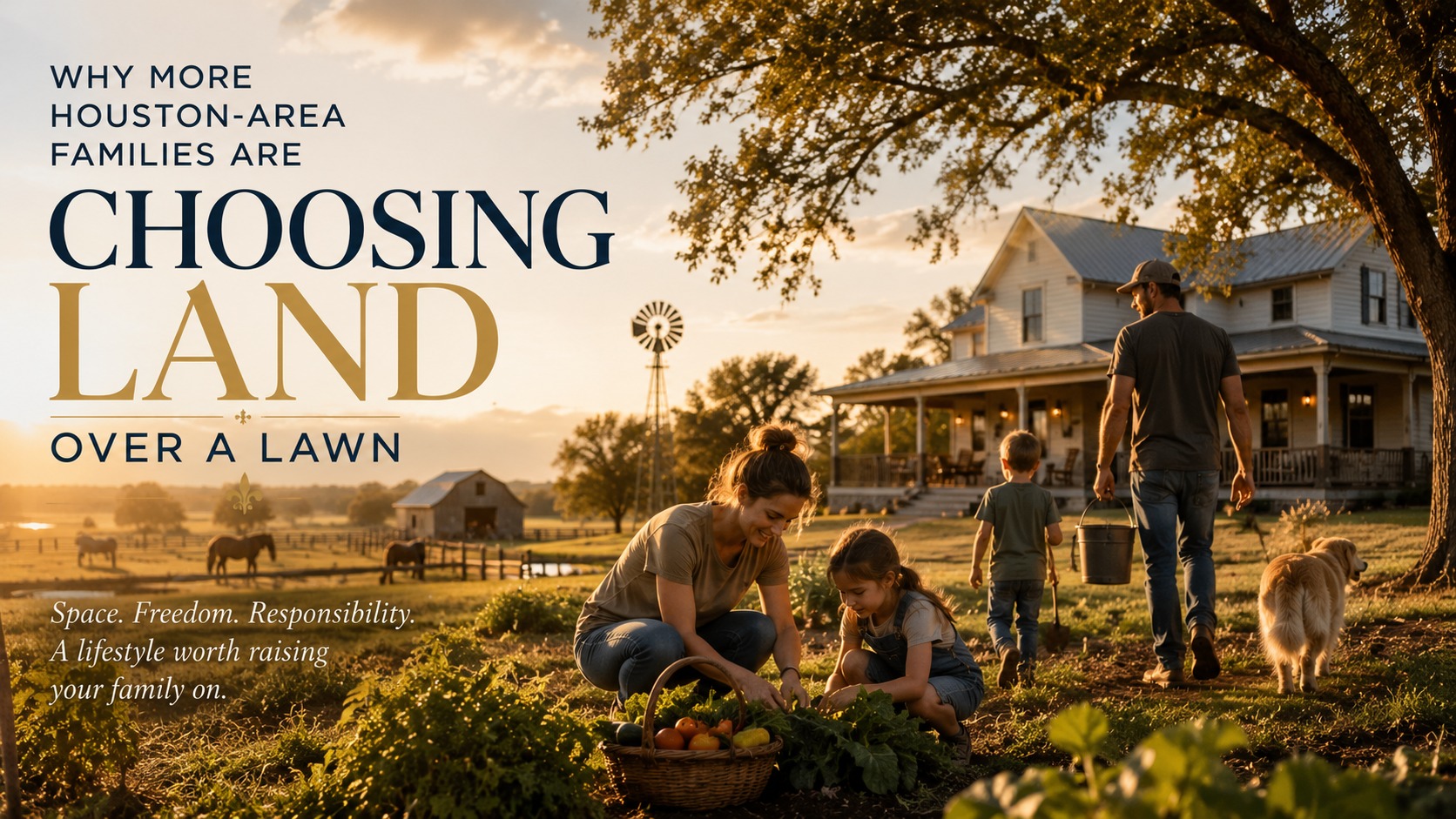
Something's shifted in the last few years, and I've watched it happen client by client rather than reading about it in a trend report. It used to be that acreage buyers were a pretty specific type — retirees wanting quiet, or people who grew up on land themselves and wanted to go back to it. Now I'm getting calls from families in their thirties and forties, still working full-time corporate jobs, who want five acres and a chicken coop. That's a real shift, and it's worth talking about honestly, because the reasons are more varied than "everyone wants to be a homesteader now."
Remote work changed the math first. This is the biggest, most obvious driver, and it's not close. When your job doesn't care whether you're forty minutes from downtown or four minutes, the entire calculation of where to live gets rewritten. A lot of the families I'm working with on acreage right now have one or both spouses working remote or hybrid, and the commute penalty that used to rule out rural living just doesn't apply the same way anymore. That's not a small factor. It's arguably the single thing that made this whole shift possible for people who couldn't have considered it a decade ago.
There's a real, if sometimes overstated, food security conversation happening. I don't want to be dramatic about this one, because most of my clients buying acreage are not building bunkers. But there is a genuine, quieter motivation running underneath a lot of these conversations — people who watched grocery prices climb, watched supply chains hiccup during the pandemic, and came away wanting a little more control over at least some of what their family eats. A garden. A few chickens for eggs. Maybe a couple of goats down the line. It's less "prepper" and more "I'd like to not be entirely dependent on a system I don't control," which is a pretty reasonable thing to want.
A lot of it, honestly, comes down to the HOA. I'd say a genuine majority of my homestead-minded clients name this directly, sometimes as the very first thing out of their mouth: they want unrestricted land specifically because they're done asking permission for what color to paint a shed or whether they're allowed to keep chickens. HOA disdain has become something close to a universal reaction at this point, and I'll be fair to HOAs for a second — they're not the villain in every story. They exist to protect property values and keep a subdivision looking consistent, and plenty of people genuinely want that predictability. But for someone whose whole plan involves a barn, a garden that isn't tidy on a schedule, or livestock, an HOA isn't a minor inconvenience — it's a direct obstacle to the entire lifestyle, and often a dealbreaker dressed up as a deed restriction.
There's also a pull toward real community, not just space. This one surprises people, because the instinct is to assume homesteaders are chasing isolation. Most aren't. What I hear more often is a desire for the kind of communal connection that a lot of typical suburban or urban neighborhoods just don't offer anymore — knowing your neighbors, trading eggs for tomatoes, helping each other with a fence line or a barn raising, kids who grow up in and out of each other's yards. It's less “leave everyone behind” and more “build the kind of neighborly closeness that a lot of modern neighborhoods have quietly lost,” which is a different motivation than the acreage-and-privacy narrative usually gets credit for.
Kids are a bigger factor than people admit up front. Almost every family I work with on this ends up telling me some version of the same thing: they want their kids to have actual responsibility. Chores that matter. An animal that depends on them. Space to be loud and messy and outside without a neighbor's fence eight feet away. That's not nostalgia for a lifestyle nobody in the family actually lived — it's a genuine reaction to how boxed-in suburban childhood can feel, and it's one of the more emotionally honest reasons people give me, usually somewhere around the second or third conversation once they've stopped leading with the practical stuff.
Here's the myth I want to bust directly: homesteading doesn't have to mean total self-sufficiency. This is the part that stops people before they even start looking, because they picture the extreme version — off-grid, canning everything, raising and butchering their own meat — and decide it's not for them. Most of my clients doing this are running a hybrid version. A big garden and a day job. A few backyard chickens and a Costco run every two weeks. An ag exemption on part of the property and a completely normal suburban-adjacent life on the rest of it. There's no purity test here. The families who do this successfully long-term are almost always the ones who picked the version that fit their actual life, not the version they saw on a homesteading Instagram account.
If any of this sounds like where your family's headed, the conversation I always start with is the same one: what do you actually want this land to give you, day to day, not in some idealized future version of your life. That answer shapes everything else — how much acreage you need, how far out you're willing to go, whether an ag exemption is even relevant to what you're picturing. It's a genuinely different way of living than most of Houston is used to, and it deserves a plan built around your real life, not somebody else's.
Talk to Fay
Thinking through what land could actually give your family? Let's talk through what fits your real life, not the Instagram version.
Book a Free Consultation →