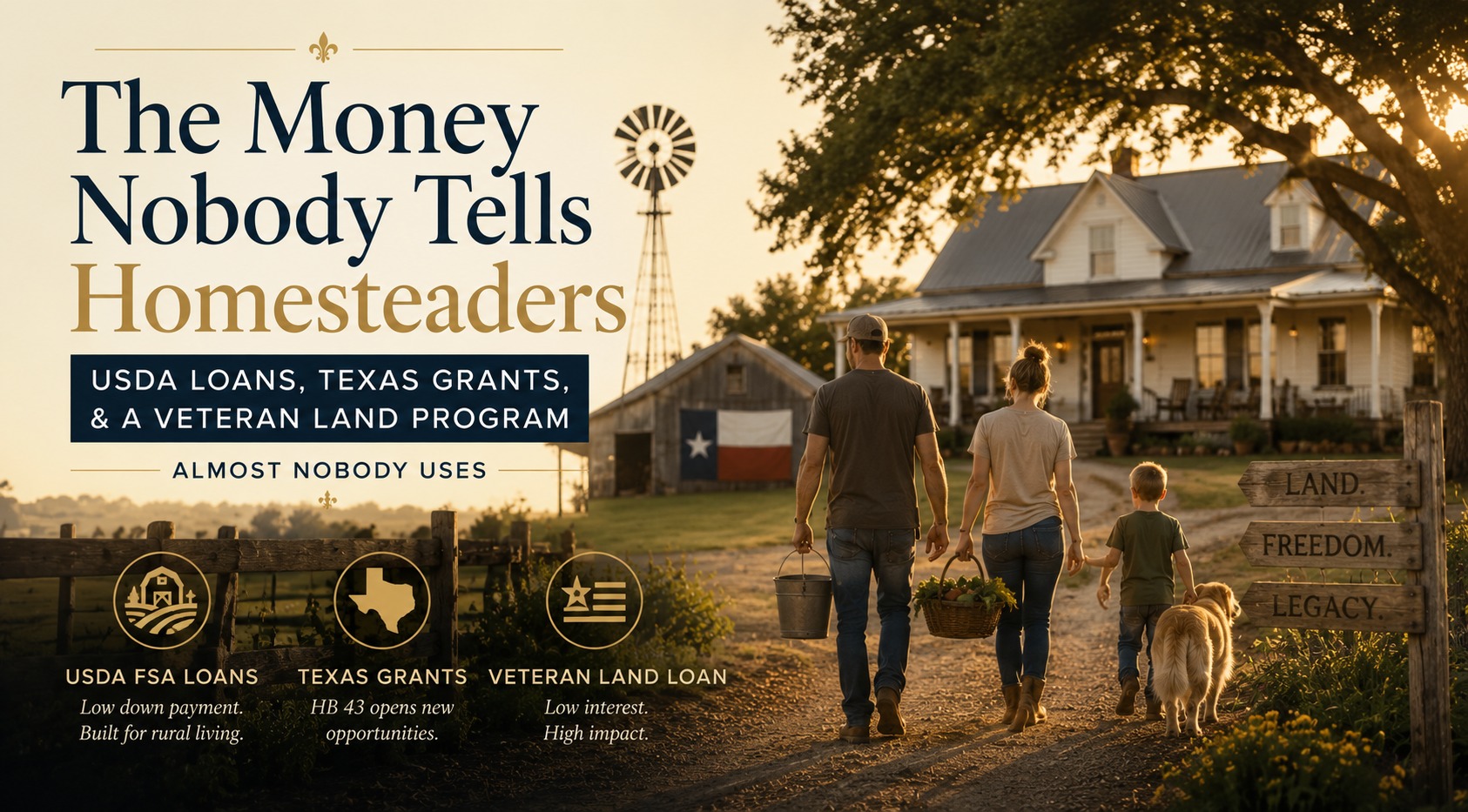
Every homesteading conversation eventually turns to money, and I understand why people brace for that part — land, a well, fencing, maybe a barn, it adds up fast. What surprises almost everyone I talk to is how much real funding actually exists for exactly this kind of purchase. Not vague "programs exist somewhere" funding. Actual federal loan programs with real numbers, a Texas grant program that just got dramatically better, and a state land loan for veterans that only about one in eight eligible people even use. Let me walk through what's actually available right now.
USDA Farm Service Agency loans — the federal backbone of ag financing. The FSA offers several loan types, and the one most relevant to someone just starting out is the Microloan: up to $50,000, with streamlined paperwork and reduced experience requirements. You can even substitute a mentor relationship for part of the usual three-years-of-farming-experience rule, which matters a lot if you're coming from a completely different career. Microloans can cover equipment, minor property improvements like a well or a hoop house, irrigation, even a delivery vehicle if your homestead includes any kind of small farm income.
Beyond microloans, Direct Farm Ownership Loans go up to $600,000 for buying land itself, with a current rate around 5.5%, and beginning farmers specifically qualify for a 5% down payment option — genuinely low compared to a conventional land loan. Direct Operating Loans go up to $400,000 for the operational side. And if you need more than FSA lends directly, Guaranteed Loans — where a bank lends and USDA guarantees up to 95% of it — go as high as $2.24 to $2.28 million for larger operations. Beginning farmers get priority access and dedicated funding set-asides across all of these categories, and your local county FSA office, not NRCS, is the right first call — NRCS handles conservation cost-share, a different program entirely, and mixing the two up is one of the most common early mistakes I see.
Grants, not loans, if you qualify. The Beginning Farmer and Rancher Development Program funds roughly $44 million a year, though that money mostly flows to training and education organizations rather than directly into an individual's pocket — worth knowing so you don't go looking for a check that isn't coming your way. More directly useful: NRCS's EQIP program offers conservation cost-share with an advance-payment option specifically for beginning and historically underserved producers, covering 50% or more of the cost upfront, provided you spend it within 90 days.
The Texas program that just got dramatically better: the Texas Agricultural Grant Program. This used to be the Young Farmer Grant Program, and it was fine but limited — ages 18 to 46 only, grants capped at $20,000, and a full dollar-for-dollar match requirement that put it out of reach for a lot of people. House Bill 43, passed in the 2025 legislative session, overhauled the whole thing. The age restriction is gone entirely. The grant cap jumped to $500,000. The match requirement dropped to just 10% instead of 100%. A companion interest-rate-reduction loan program also saw its cap rise to $1 million. This is genuinely new, genuinely underused simply because most people haven't heard the program changed, and it's worth checking texasagriculture.gov directly for current rollout details before you assume the old, more restrictive rules still apply.
For Texas veterans specifically, there's a program that deserves far more attention than it gets: the Texas Veterans Land Board. This is a state program, not a federal VA benefit, and it's genuinely excellent for exactly the kind of purchase this whole series has been about. Texas veterans and active-duty service members can borrow to buy 1 to 20 acres anywhere in the state with as little as 5% down — including raw, unimproved land that most conventional lenders won't touch. Loan limits rose in 2026 to $200,000 for an individual veteran and $275,000 for a dual-veteran household, with fixed rates and terms up to 30 years. It's explicitly usable for farming or recreational land, not just a home site, and it stacks with a standard VA home loan if you want to build later — buy the land through VLB, build on it with a separate VA construction loan down the line. Despite all of that, only about 12% of eligible veterans actually use it. If you're a veteran considering this move, this is the first program to look into, not an afterthought.
On the nonprofit side, a few smaller but genuinely useful options for veterans specifically: the Farmer Veteran Coalition Fellowship Fund offers $1,000 to $5,000 in direct-to-vendor grants for startup equipment and needs — paid to the vendor, not the veteran, but real money toward real gear. The USDA's AgVets program funds hands-on training built specifically for veterans transitioning into agriculture. And federal USDA programs generally classify veteran producers as "historically underserved," which unlocks priority funding treatment and lets veterans substitute military leadership experience for part of the usual farm-experience requirement on FSA loans.
The honest bottom line: the money to make this move exists in more forms than most people researching homesteading ever discover, because a lot of it sits scattered across federal agencies, a state land board, and nonprofit organizations that don't advertise loudly. If you're seriously considering acreage, I'd rather you know about all of this before you assume you need to save up the full purchase price in cash. Talk to your local FSA county office, check the Texas Agricultural Grant Program's current rules directly, and if you're a veteran, put the VLB program at the top of your list, not the bottom.
Talk to Fay
Weighing acreage and want to talk through what funding might actually fit your situation? Let's map it out together.
Book a Free Consultation →