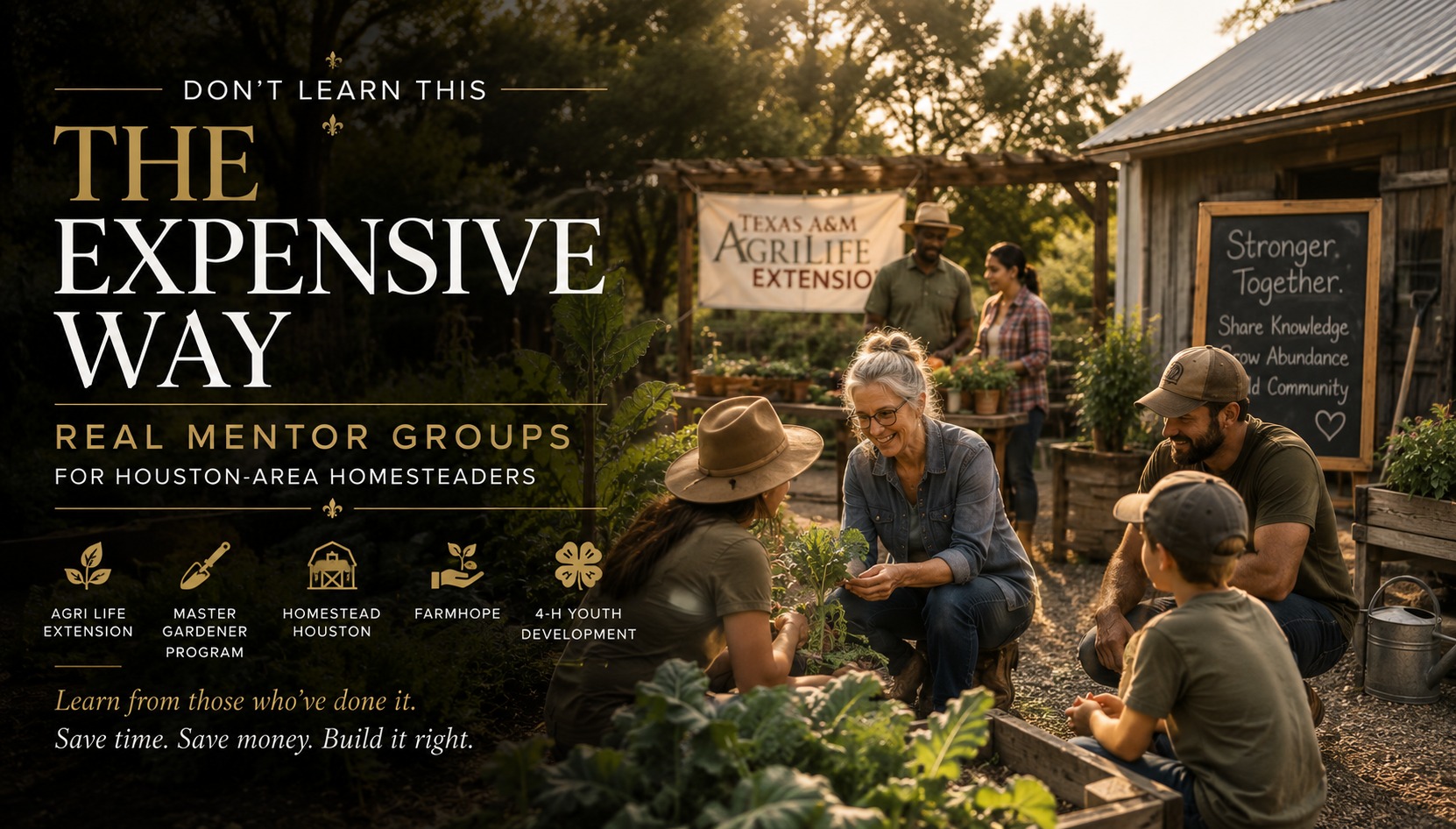
Almost every costly homesteading mistake I hear about from clients has the same origin story: nobody told them, so they found out the hard way. A fence built in the wrong spot relative to a easement. A well drilled before checking the county's groundwater conservation district rules. Chickens bought in spring without a plan for what a Houston summer does to a coop with poor ventilation. None of these are stupid mistakes. They're just the predictable result of doing something for the first time with no one to ask beforehand. The good news is Houston has a genuinely strong, if under-advertised, network of people who've already made these mistakes and are willing to save you the trouble.
Texas A&M AgriLife Extension — Harris County office, and specifically their Beginning Farmer resources. This is the single best starting point I point people toward, and I don't think enough homesteading-curious families know it exists as a free public resource. AgriLife Extension runs research-backed, hands-on guidance on everything from soil testing to livestock basics to what actually grows well in our specific clay-heavy, humid-summer conditions. Their Beginning Farming program specifically addresses startup logistics, funding awareness, and land-use questions — the exact stuff that trips up first-year homesteaders. It's staffed by actual agricultural specialists, not volunteers guessing, and it's free.
The Texas Master Gardener program. Also run through AgriLife, this is a volunteer-certified program that trains people in horticulture and then puts that knowledge back into the community through public education, demonstration gardens, and yes, answering questions from people like you. If your homesteading plans lean heavily toward growing food rather than livestock, this is a deep well of free, locally-calibrated expertise — people who already know which tomato varieties actually survive a Houston July and which ones just look good in a seed catalog.
Homestead Houston. This is the real, if less official, backbone of the local homesteading community — a genuine meetup and workshop network where people actually doing this share what's working and what isn't. The value here isn't credentialed expertise so much as lived experience from people one or two steps ahead of you on the same path. If AgriLife is the classroom, this is closer to the community that shows up to help you build the fence.
FarmHope. I want to include this one even though it's not the obvious "how do I raise goats" resource, because I think it matters more than people expect going in. FarmHope provides free mental health counseling specifically for Texas agricultural producers and their families. Homesteading and small-scale farming carry real stress — financial risk, physical demands, isolation for some families, the weight of caring for animals that depend on you. This kind of support existing, for free, specifically for people in this exact situation, is worth knowing about before you need it, not after.
4-H, if kids are part of the picture. Beyond the classic county-fair image, 4-H is a genuinely structured way for kids to take real ownership of an animal project or a garden plot with adult mentorship built in. For families who told me raising kids with real responsibility was part of why they wanted this lifestyle in the first place, 4-H is often the most direct path to that specific goal, with a built-in community of other homesteading and ranching families around it.
A pattern worth naming directly: almost nobody makes these mistakes because they're careless. They make them because they didn't know who to ask. That's really the throughline of everything in this post. The land-use question, the funding program, the schooling law, the fence placement — all of it exists somewhere as known information held by someone who's already been through it. The entire point of a mentor network is closing that gap before it costs you money or time.
If you're seriously considering this move, I'd treat building a short list of these contacts the same way you'd treat lining up your lender or your inspector — not an optional extra step, but part of the actual plan. I'm happy to make introductions where I can, and if there's a specific piece of this — animals, funding, land, schooling — you want to go deeper on, that's exactly what the rest of this series has been for.
Talk to Fay
Starting to plan your homestead move and want to talk through what a realistic first year looks like? Let's map it out.
Book a Free Consultation →